
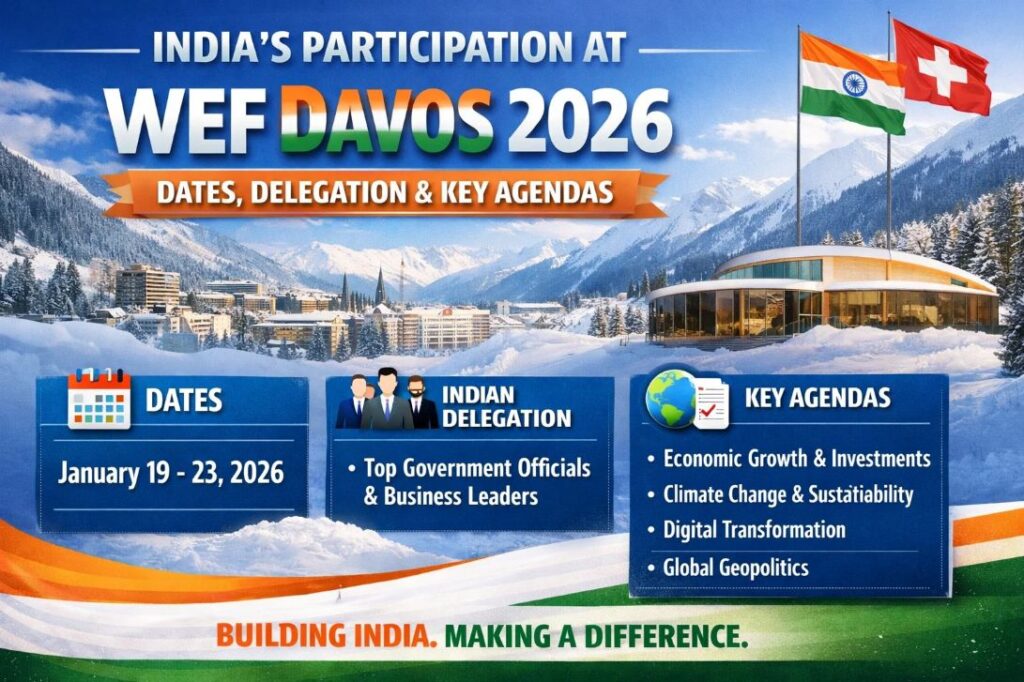
The World Economic Forum (WEF) Annual Meeting 2026 is a landmark global event where business leaders, policymakers, CEOs, entrepreneurs, and heads of state converge to discuss pressing economic, technological, and social issues. This year’s summit — themed “A Spirit of Dialogue” — is being held in Davos-Klosters, Switzerland, from January 19 to 23, 2026. India’s involvement at Davos 2026 marks one of the most significant global appearances by the country’s political and corporate leadership in recent years.
India’s participation reflects not only its economic growth trajectory but also its ambition to shape global policy dialogues, attract investment, and expand international partnerships. Over the five days, Indian representatives will engage with global leaders on themes such as innovation, AI governance, sustainable development, infrastructure, investment partnerships, and trade.
Overview: Event Dates, Theme, and Global Context
| Item | Details |
|---|---|
| Event | World Economic Forum Annual Meeting 2026 |
| Theme | “A Spirit of Dialogue” |
| Dates | January 19–23, 2026 |
| Location | Davos-Klosters, Switzerland |
| Participants | ~3,000 leaders from 130+ countries |
| Key Attendees | Heads of state, CEOs, policymakers, experts |
The WEF Annual Meeting serves as a global platform for dialogue among leaders from different sectors, including government, business, civil society, and academia. Discussions this year are expected to emphasize economic resilience, technological transformation, AI governance, and equitable global growth.
India’s Delegation at Davos 2026
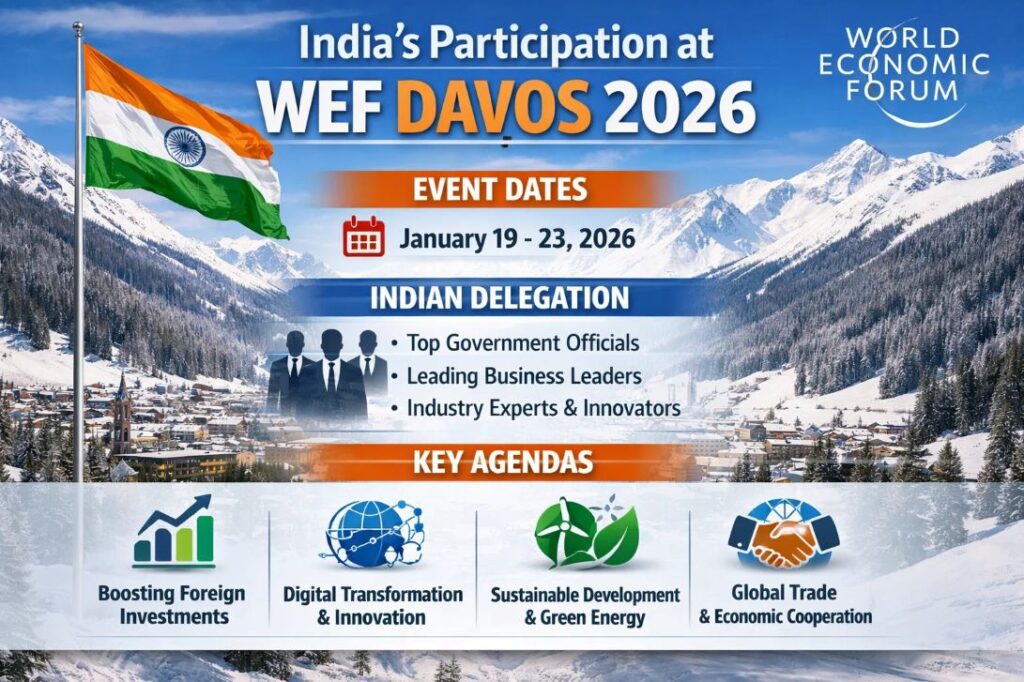
India will have a robust and diverse delegation at WEF Davos 2026, encompassing government ministers, chief ministers (CMs), business leaders, and organizational representatives. The delegation aims to highlight India’s economic progress, investment opportunities, technological innovation, and sustainability narratives.
Government Representatives
| Category | Representatives | Focus Areas |
|---|---|---|
| Union Ministers | Ashwini Vaishnaw, Shivraj Singh Chouhan, Pralhad Joshi, K Rammohan Naidu | National economic reforms, infrastructure, energy, civil aviation |
| Chief Ministers | Devendra Fadnavis (Maharashtra), N. Chandrababu Naidu (Andhra Pradesh), Himanta Biswa Sarma (Assam), A. Revanth Reddy (Telangana), Mohan Yadav (Madhya Pradesh), Hemant Soren (Jharkhand) | State investment pitches, sectoral growth, job creation |
| Deputy Chief Ministers | Harsh Rameshbhai Sanghavi (Gujarat), Uttar Pradesh delegation (incl. deputy ministers) | Industrial investment, semiconductors, renewable energy |
Unlike previous editions, this year’s Indian government presence is broad, involving a mix of economic, industry, and state leadership to present a holistic growth narrative.
Corporate Leaders and Indian CEOs
India’s corporate presence at Davos 2026 is also noteworthy, with over 80 top CEOs and business executives expected to participate in panel discussions, bilateral meetings, and side events. The Indian corporate delegation reflects the country’s business strength across sectors — from traditional industries to new-economy firms.
| Business Leader | Organization |
|---|---|
| Mukesh Ambani | Reliance Industries |
| N Chandrasekaran | Tata Sons |
| Sanjiv Bajaj | Bajaj Group |
| Sunil Bharti Mittal | Bharti Group |
| Sudarshan Venu | TVS Motor |
| Nandan Nilekani | Infosys Co-founder |
| Salil Parekh | Infosys CEO |
| Rishad Premji | Wipro Chair |
| Amitabh Chaudhry | Axis Bank |
| Nikhil Kamath | Zerodha |
| Prashant Ruia | Essar |
| Sumant Sinha | ReNew Power |
These business leaders are expected to engage global executives on investment priorities, technology innovation, supply chain resilience, and cross-border partnerships.
Regional and Sectoral Delegations
In an ambitious push to showcase regional strengths and investment opportunities, several Indian states are deploying strong delegations to engage international investors and industry leaders.
| State | Delegation Leader | Key Focus |
|---|---|---|
| Gujarat | Deputy CM Harsh Sanghavi | Defence, semiconductors, green investments |
| Assam | CM Himanta Biswa Sarma | First time participation, investment showcase |
| Jharkhand | State Pavilion | Natural resources, industrial growth |
| Telangana | CM A. Revanth Reddy | Telangana Life Sciences Policy, AI Hub |
| Maharashtra | CM Devendra Fadnavis | Industrial cooperation and investment |
| Andhra Pradesh | CM N. Chandrababu Naidu | Export markets and tech partnerships |
These state delegations aim to attract foreign direct investment (FDI), highlight business opportunities, and establish global linkages for local industries.
India’s Strategic Agendas at Davos 2026
India’s participation is not ceremonial; it is strategic and multi-layered. The Indian delegation is expected to engage in several high-priority agenda areas that align with national focus and global challenges.
1. Investment Attraction and Economic Positioning
India will present itself as a stable, resilient investment destination amidst global uncertainties — including geopolitical tensions and tariff concerns. Discussions will showcase the country’s growth story and long-term capital attraction potential.
2. Technology and Innovation Engagement
A significant theme at Davos 2026 is innovation, particularly around artificial intelligence (AI) and digital transformation. India’s leadership and corporate representatives will participate in dialogues aimed at shaping the future of technology governance, innovation ecosystems, and digital inclusion.
3. Global Trade and Economic Partnerships
India is expected to solidify its global partnerships, especially in infrastructure, manufacturing, energy, and services. Panels and bilateral meetings will explore trade corridors, investment pipelines, and policy collaborations.
4. Sustainability and Inclusive Growth
Initiatives on sustainability, climate action, and equitable growth are core parts of the WEF agenda. India will highlight programmes aimed at inclusive development, renewable energy adoption, and collaboration with global partners for sustainable policies.
5. Entrepreneurship and MSME Growth
Smaller enterprises and entrepreneurship are also in focus. For example, the Dalit Indian Chamber of Commerce and Industry (DICCI), led by IIM Jammu chairman Milind P. Kamble, is engaging at WEF to project India’s entrepreneurship story, especially for inclusive business ecosystems.
Structured Breakdown of Key Engagement Areas
| Engagement Area | Objective | Expected Outcome |
|---|---|---|
| Investment promotion | Attract long-term capital | MoUs and partnerships |
| Tech dialogue | Shape AI governance | Inclusive digital growth |
| Trade and exports | Strengthen corridors | Expanded exports |
| Sustainability policy | Climate and ESG focus | Global alignment |
| Regional showcases | State-level investment pitches | FDI in states |
These engagement areas reflect India’s multi-pronged approach to leveraging Davos as a catalyst for growth, influence, and global cooperation.
Benefits of India’s Participation
India’s presence at WEF Davos 2026 delivers strategic benefits that extend beyond the summit’s five days.
| Benefit Category | Description |
|---|---|
| Global Visibility | India’s leaders and businesses gain global attention |
| Investment Opportunities | Showcases projects to international capital |
| Policy Influence | Shapes global economic discussions |
| Networking | CEO-to-leader dialogues and partnerships |
| Branding | Positions India as a future-ready economy |
The collective presence — governmental and corporate — enhances India’s global narrative on stability, opportunity, and innovation.
Looking Ahead: Post-Event Legacy
The outcomes from Davos often translate into strategic collaborations, investment flows, policy partnerships, and bilateral agreements. India’s efforts at WEF 2026 may influence investor sentiment, trade strategies, technology partnerships, and global cooperation frameworks in the year ahead and beyond.
Whether it is strengthening state investments, enhancing global supply chains, shaping AI governance, or aligning with sustainability goals, India’s delegation is positioned to drive meaningful engagement with the world’s decision-makers.
Connect with us to explore how CEO coaching with Jai Sethi can help you lead growth with clarity, confidence, and control.
👉 Book Your Consultation Today
📞 Contact Us | 🌐 www.jaisethi.com
Let’s Turn your Ideas into Reality
Email: info@jaisethi.com
Mobile: +91-9971069889, 9540003547
General FAQs about WEF Davos 2026
1. What is the World Economic Forum (WEF) Annual Meeting?
The World Economic Forum Annual Meeting is a global summit held every year in Davos, Switzerland, bringing together world leaders, CEOs, policymakers, economists, and innovators to discuss major global challenges and opportunities.
2. When will WEF Davos 2026 take place?
WEF Davos 2026 is scheduled for January 2026, typically held in the third or fourth week of January, following the traditional WEF calendar.
3. Where is WEF Davos 2026 held?
The meeting is held in Davos-Klosters, Switzerland, a global hub for economic and geopolitical dialogue during the annual forum.
4. What is the theme of WEF Davos 2026?
The theme of WEF Davos 2026 is “A Spirit of Dialogue”, focusing on rebuilding trust, cooperation, and resilience amid global economic and geopolitical challenges.
5. Why is WEF Davos important globally?
WEF Davos is important because it shapes global economic thinking, policy direction, investment flows, and leadership conversations across governments and industries.
India at WEF Davos 2026
6. Why is India’s participation at WEF Davos 2026 significant?
India’s participation highlights its growing role as a global economic powerhouse, innovation hub, and strategic partner in global growth, manufacturing, and technology.
7. How does India benefit from attending WEF Davos?
India benefits by attracting foreign investment, strengthening global partnerships, promoting its states and industries, and positioning itself as a stable, high-growth economy.
8. What is India’s key message at Davos 2026?
India’s message focuses on economic resilience, digital leadership, manufacturing growth, sustainability, and inclusive development.
9. How is India positioning itself at WEF Davos 2026?
India is positioning itself as a trusted global partner, investment-friendly destination, and a leader in technology, manufacturing, and sustainable growth.
10. Is India one of the most visible countries at Davos 2026?
Yes, India is among the most visible and active participants, with strong representation from government leaders, CEOs, and state delegations.
Indian Delegation and Leadership
11. Who represents India at WEF Davos 2026?
India is represented by senior government officials, cabinet ministers, chief ministers, top Indian CEOs, industry leaders, and startup founders.
12. Do Indian CEOs attend WEF Davos regularly?
Yes, leading Indian CEOs from sectors such as manufacturing, IT, finance, energy, and infrastructure regularly attend Davos.
13. Why do Indian CEOs attend WEF Davos?
Indian CEOs attend Davos to build global partnerships, explore investments, understand global trends, and position their companies internationally.
14. Are Indian state governments present at Davos 2026?
Yes, multiple Indian states participate to promote investment opportunities, infrastructure projects, and regional growth initiatives.
15. What role do Indian states play at Davos?
Indian states showcase sector-specific investment opportunities, policy reforms, and ease-of-doing-business initiatives to global investors.
Business, Investment, and Economic Impact
16. How does WEF Davos help India attract investment?
Davos provides a global platform where India can directly engage with investors, sovereign funds, and multinational corporations.
17. Which sectors does India promote most at Davos?
India promotes manufacturing, renewable energy, infrastructure, technology, digital economy, healthcare, and logistics.
18. Does Davos result in real business outcomes for India?
Yes, Davos often leads to MoUs, investment commitments, strategic partnerships, and follow-up negotiations.
19. How does Davos support India’s manufacturing growth?
India uses Davos to promote initiatives like industrial corridors, advanced manufacturing, and supply chain diversification.
20. How important is Davos for India’s long-term economic strategy?
Davos plays a strategic role in reinforcing India’s long-term goals around growth, global integration, and economic leadership.
Technology, AI, and Innovation
21. What role does technology play in India’s Davos agenda?
Technology is central, with focus on AI, digital public infrastructure, fintech, and emerging technologies.
22. How does India address AI discussions at Davos 2026?
India emphasizes responsible AI, innovation-driven growth, and inclusive digital transformation.
23. Are Indian tech companies visible at Davos?
Yes, Indian IT and technology leaders actively participate in panels, closed-door discussions, and global forums.
24. How does Davos benefit India’s startup ecosystem?
Davos helps Indian startups gain visibility, access global investors, and form international partnerships.
25. Does India discuss digital governance at Davos?
Yes, India contributes to discussions on digital governance, data privacy, and technology regulation.
Leadership, Strategy, and Global Influence
26. Why do global leaders pay attention to India at Davos?
India’s scale, growth rate, and demographic advantage make it a critical player in global economic discussions.
27. How does Davos influence leadership thinking in India?
Insights from Davos shape leadership strategies, corporate governance, innovation planning, and policy direction.
28. Is Davos relevant for Indian business leaders and CEOs?
Yes, Davos offers exposure to global best practices, leadership trends, and strategic foresight.
29. How does Davos strengthen India’s global partnerships?
It enables direct dialogue with governments, corporations, and institutions from across the world.
30. What does India’s strong presence at Davos 2026 indicate?
It indicates India’s growing influence, confidence, and leadership role in the global economy.
Media, Public Interest, and Search Trends
31. Why is “India Davos 2026” trending in searches?
Public interest is driven by India’s strong delegation, major announcements, and global media coverage.
32. How does media coverage benefit India at Davos?
Media visibility enhances India’s global brand, investor confidence, and international credibility.
33. Why should professionals follow Davos news?
Davos insights help professionals understand future economic, leadership, and industry trends.
34. Is WEF Davos relevant beyond policymakers?
Yes, it is highly relevant for business leaders, entrepreneurs, investors, and senior professionals.
35. How does Davos impact global trust and cooperation?
Davos fosters dialogue and collaboration at a time of global uncertainty and geopolitical tension.
Practical FAQs
36. Is WEF Davos open to the public?
No, it is an invitation-only event for selected leaders and organizations.
37. How long does WEF Davos last?
The annual meeting typically lasts 4 to 5 days.
38. Does India announce policies at Davos?
While formal policy announcements may happen later, Davos is used to signal intent and direction.
39. Can Indian companies gain clients through Davos?
Yes, many companies use Davos for networking, deal-making, and relationship building.
40. What is the long-term value of Davos for India?
The long-term value lies in stronger global positioning, partnerships, and sustained economic engagement.